Driving in Slovakia is usually manageable, especially if you plan on renting a car to explore the country at your own pace. You must follow local traffic rules, which may differ from those in your home country.
Speed limits are shown in kilometres per hour (km/h), and police can stop you to check documents and road charges such as the motorway vignette. Our guide keeps things simple, so you can drive with confidence while still staying safe and legal.
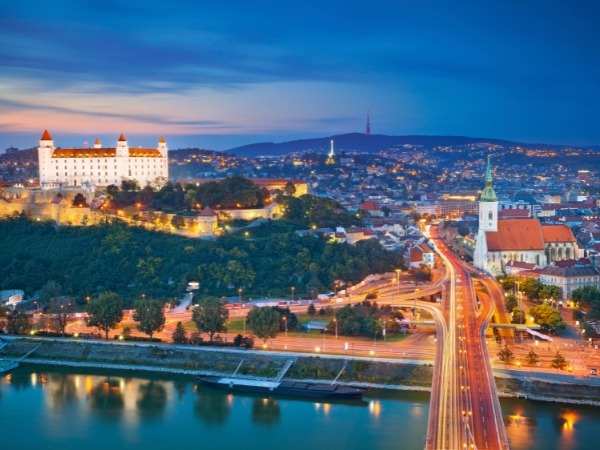
Driving in Slovakia is the best option if you want freedom to stop, change plans, and explore a bit more than a fixed bus or train timetable allows. Technically, many trips are short in distance but slow in time because roads can change from multi-lane highways to two-lane routes outside bigger towns.
Driving is ideal if you are travelling as a couple, family, or small group, because you can share the cost and carry day-hike, ski, or picnic gear. If you are staying outside the city centre, a car is useful for shopping, reaching trailheads early, and avoiding late buses back from nature areas.
Roads in Slovakia are safe and well-maintained, and you may see more four-lane highways around Bratislava. Outside well-developed areas, many roads remain two-lane.
On single-carriageway roads (one lane each way), overtaking can be risky. You may see drivers trying to pass when they should not. Road markings can also be hard to see in poor weather or when they are faded, so keep extra space and do not rush.
Before you drive, you need the right licence, the right ID, and the right proof of cover. In the EU, an EU-issued driving passport-style photocard licence is recognised across EU countries, but rules for a non-EU licence can be different, so you must check what applies to you.
If your driving licence was issued in an EU country, you can use it anywhere in the EU, including Slovakia. Your licence must be valid for the whole trip. If it expires during travel, it may not be recognised.
If you only have a provisional licence (learner permit), be careful. Provisional licences and certificates are not accepted in the same way, and you cannot rely on them for driving in another country.
For non-EU driving licences, there is no single rule. You should contact the authorities in the country you are visiting, or your embassy/consulate there, to confirm what you need.
Travellers can use a UK photocard driving licence to drive in Slovakia for up to 6 months. If you still have a paper licence, you may need to update it or get the 1968 version of the International Driving Permit (IDP).
Do not be surprised if the rental company’s rules are stricter than the law. Car rental companies in Slovakia often require things like a minimum time holding a licence (for example, one year of driving experience), a higher minimum age, and sometimes an IDP. For deposits, most companies block a credit card amount (a “pre-authorisation”) to cover excess and damage risk.
This section highlights key driving rules in Slovakia that can help drivers avoid fines and unnecessary stress. It focuses on the regulations most often enforced by police, such as speed limits, alcohol restrictions, and mobile phone use while driving. T
For a standard passenger car or van, the typical speed limits shown for Slovakia are 50 km/h in built-up (urban) areas, 90 km/h on non-urban roads, and 130 km/h on motorways/expressways.
Two important points keep you safe here. First, road signs can change the limit, so always follow the posted sign rather than “the usual number.” Second, speed limits can vary by road type and vehicle type. For example, trailers and heavier vehicles can have different limits.
Set your sat-nav to show speed in km/h, and remember that enforcement can still reach you even after you go home. EU countries share information on road safety traffic offences, so fines can sometimes arrive by post later.
Slovakia’s driving regulations are strict when it comes to alcohol. Under the driving rules, the country follows a zero-alcohol policy for drivers. Driving after drinking any amount of alcohol is illegal, and the legal blood alcohol limit is 0.0. Police may also stop vehicles randomly to conduct breath tests.
The 0.0 alcohol limit applies to professional, standard, and novice drivers, reinforcing the country’s zero-tolerance approach. If a driver is tested and any alcohol is detected in their system, they may face serious consequences, including substantial fines, possible loss of their licence, or even imprisonment.
In Slovakia, daytime running lights are mandatory even during daylight hours. This means you should switch on dipped headlights if your car does not use automatic DRLs. Check the symbols on your dashboard to ensure your lights are on.
To explain the “why” in simple terms: DRLs are designed to help other road users see you better in daytime, not just to help you see the road. They come on automatically when a vehicle’s engine starts, and they increase visibility.
Across the EU, you must wear a seat belt, and children must have appropriate child restraints. Seat belts and child restraint systems are mandatory, with specific exceptions listed for some cases.
For families, children under 12 years old, under 80 pounds, or shorter than 5 feet must use a car seat or booster seat. If you are renting a car, reserve the right child seat in advance, because “available at the desk” may not fit properly or be the wrong size.
If you are new to driving in Central Europe, the biggest “surprise moments” are usually junctions, lane discipline, and how quickly the traffic flow changes. The safest approach is to drive defensively. Slow down early, watch signs, and do not assume other drivers will wait for you.
Slovakia uses road charges, so you need a plan for tolls before you enter a paid road.
You need to buy an electronic vignette to use certain highways and motorways in Slovakia. A vignette is proof that you have paid the road charge for a set time, so you are allowed to use those specific roads during that period. Because the system is described as “electronic,” you should not buy it later. Treat it like a ticket. You want it sorted before you drive onto a paid road.
You can get a motorway vignette at all major border crossings into Slovakia and at larger petrol stations. This is useful if you are driving in from Austria, Czechia, Hungary, or Poland and you want to buy in person quickly.
If you want the most accurate, up-to-date road network map and payment instructions, the toll system operator is the source of that information. Always double-check which roads are charged, because signage and networks can change.
Vignettes are time-based user charges. The cost depends mainly on how long you need access to the charged roads and what type of vehicle you have. For the exact current prices and time options, check the official toll information before you travel.
If you use Slovak motorways (called “Dialnica”), you must have a motorway vignette; if you do not, you could face a heavy fine. Also, remember that traffic enforcement can follow you across borders in the EU. If you commit a road-safety-related traffic offence in another country, you could receive the fine by post at home later.
Tolls are distance-based and depend on vehicle type, while vignettes are time-based; they also encourage electronic collection of charges where feasible.
In practical terms, if you are driving a heavier vehicle (for example, a large campervan or minibus), you should confirm whether you stay in the vignette system or if different charging rules apply.
This section is about real driving comfort: how the motorways feel, what “normal” two-lane roads are like, and why overtaking and weather matter. Slovakia has a mix of multi-lane highways near major cities and many two-lane roads outside developed areas, so your average speed can vary significantly over the same distance.
Roads in Slovakia are generally safe and well-maintained, with four-lane highways common near Bratislava. This is where driving feels most “easy”. You could expect clear lanes, smoother flow, and more predictable driving.
Once you leave the urban areas, expect more two-lane driving in Slovakia. Most roads outside developed areas are two-lane, and it warns that at night they can be narrow, winding, and poorly lit.
Many main roads have only one carriageway in each direction, which makes overtaking difficult. Watch for oncoming cars overtaking on your side. Note that road markings can be hard to see in poor weather or when faded.
If your trip includes colder months or higher areas, take winter seriously. Slovakia can get heavy snow from November to March (especially in the northern mountains). Snow removal on rural roads is often inadequate, making conditions dangerous. Winter tyres are required for snowy conditions, and chains are required in certain mountainous areas.
The biggest advantage of driving in Slovakia is the freedom it gives you. Stay patient on smaller roads, plan a little ahead for tolls and weather, and drive defensively. These simple habits can make your journey smoother, safer, and far more enjoyable.
Rent a car in Slovakia with Final Rentals for reliable cars, easy booking, and a smooth travel experience. Select Bratislava Airport as your pickup location, enter your travel dates, and choose a vehicle for your trip. Book and manage your car rental at any time. Download the Final Rentals app on Google Play and the App Store.
Car renters need an electronic vignette for certain highways and motorways. You can face a heavy fine if you use motorways without it.
Slovakia has a zero-alcohol rule for driving. Driving after drinking any alcohol is illegal, and the legal blood alcohol limit is zero.
Under the driving rules, drivers must travel on the right-hand side of the road, and overtaking is done on the left.